
The Price Index (2026)
by Derek Siegel
Outdoor gear is getting more expensive.
A technical shell increasingly lands around $400–$600. Trail shoes routinely push toward $180–$200. A fleece from a small independent label can cost $250. Technical pants have moved comfortably beyond $150, while even caps, socks and bottles increasingly occupy price points that would have looked unusual a decade ago.

It's easy to explain this as outdoor becoming fashion—or brands simply charging more because consumers have demonstrated they'll pay it.
That's part of the story.
But the price tag hanging from a jacket in 2026 is also increasingly a record of what's happening thousands of miles away: tariffs, currency movements, energy prices, factory capacity, shipping routes, raw-material costs and geopolitical decisions.
For this edition of the WeekEnds Market Report, we're introducing The Price Index: a snapshot of what it actually costs to participate in outdoor culture right now—and why those prices keep moving.
The New Outdoor Uniform
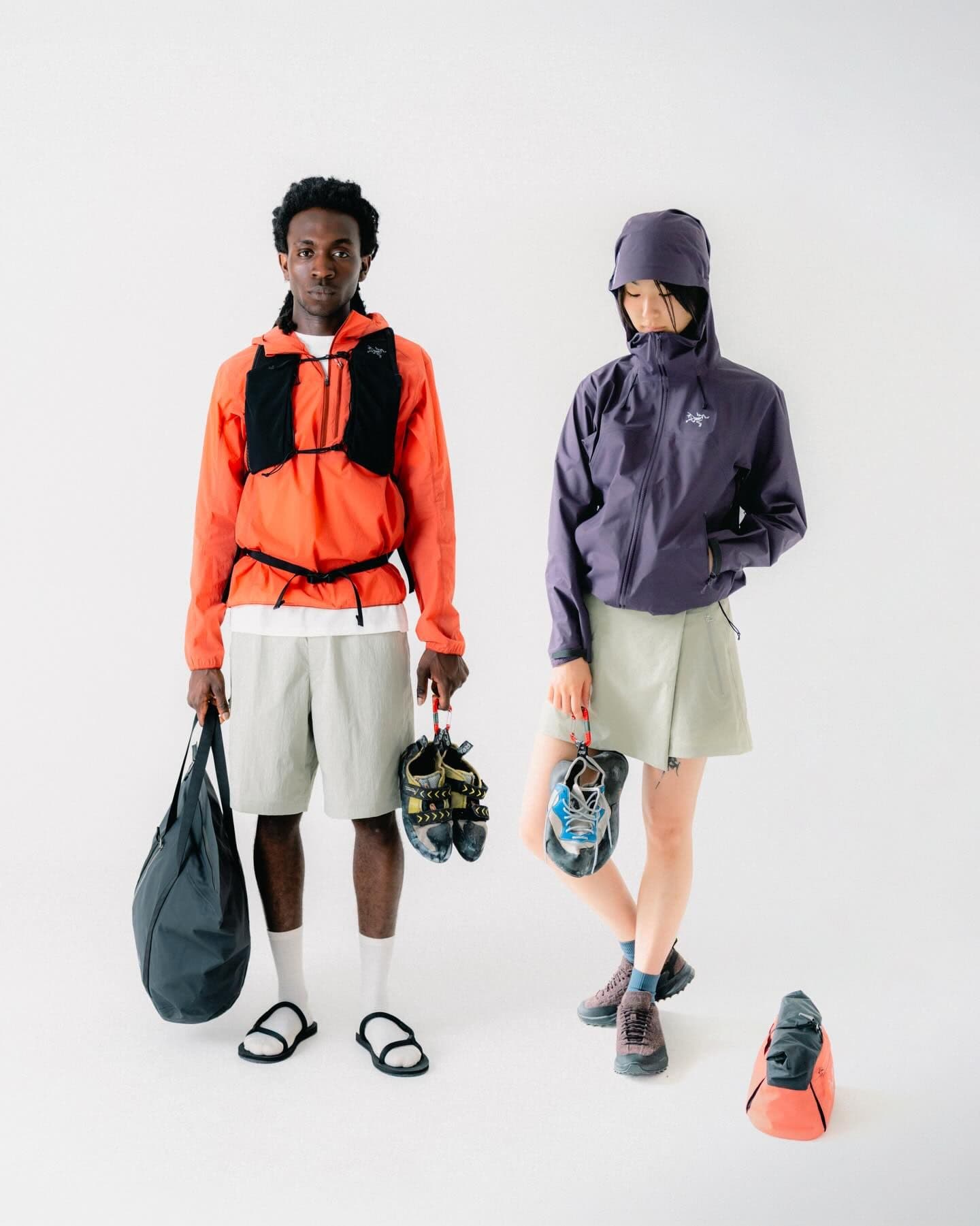
Start with the basic kit.
A technical shell increasingly lands around $400–$600. A good fleece or insulating midlayer sits around $150–$300. Trail shoes regularly cross $150, while more technical or fashion-oriented models approach or exceed $200. Packs that once felt expensive at $200 increasingly occupy the $250–$400 range.
Put together a contemporary outdoor uniform—shell, fleece, pants, trail shoes and pack—and spending $1,000–$1,500 no longer requires choosing the most expensive products in each category.
Outdoor has historically justified those prices differently than fashion. The argument was durability: you weren't buying another jacket; you were buying the jacket you'd use for years. Materials were expensive. Construction was specialized. Performance had measurable value.
Those things remain true.
But they're no longer the entire explanation.

The Price Tag Starts at the Factory
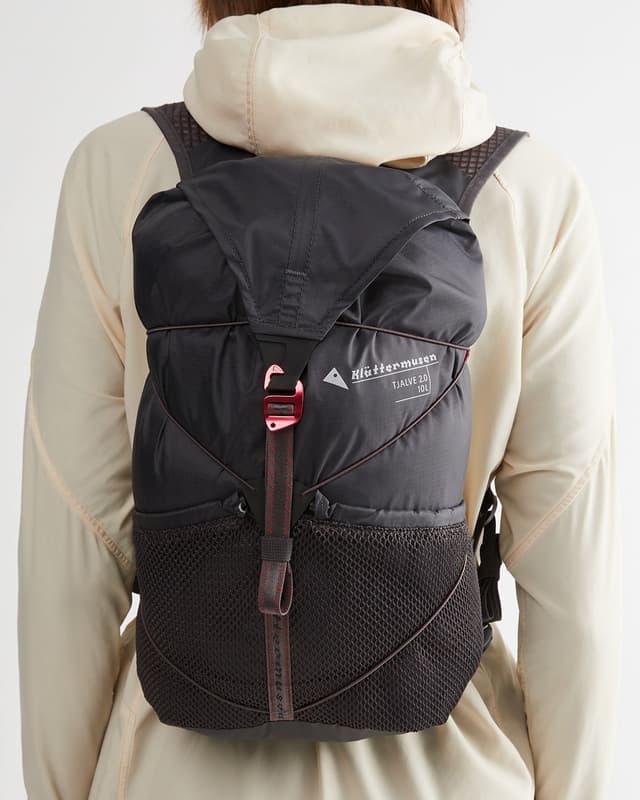
Most outdoor products are the result of a surprisingly international supply chain.
A jacket might use nylon manufactured in one country, a membrane from another, zippers from Japan, insulation produced elsewhere and final assembly in Vietnam. Footwear can involve an even more complicated network of foam, rubber, textiles, molded components and assembly factories spread across multiple countries.
For decades, that system was optimized around a relatively predictable assumption: global trade would continue getting easier.
That assumption no longer feels particularly safe.
The outdoor industry is navigating an era in which the cheapest factory price doesn't necessarily produce the cheapest finished product. Brands increasingly have to calculate landed cost—the factory price plus duties, freight, insurance, warehousing, customs, financing and the cost of holding inventory while it travels around the world.
That number is becoming much harder to predict.
The Tariff Is Part of the Product Now
Apparel and footwear are particularly exposed.
Even before the newest trade actions, many clothing and footwear categories already carried significant import duties. In 2026, the U.S. added another layer of complexity. New Section 301 measures effective July 24 imposed additional duties of 10% or 12.5% on goods from 60 economies, depending on the exporting country's status under the policy.
Vietnam is particularly important to outdoor.
After years of brands diversifying production away from China, Vietnam became the largest apparel exporter to the U.S. Yet under the latest rules, Vietnamese goods face a 12.5% additional tariff, while competitors including Bangladesh, Cambodia, Indonesia and Malaysia face 10% and may have access to a mechanism capable of reducing duties on qualifying textile trade.
That creates an uncomfortable reality for brands that spent years moving production.

The industry was encouraged by earlier trade policy to diversify away from China. Footwear companies responded aggressively: China's share of U.S. footwear imports fell from 87% by volume in 2009 to roughly 48% in 2025. Much of that production moved toward Vietnam, Indonesia, Cambodia, Bangladesh and India.
Now some of those same sourcing hubs are facing additional tariffs of their own.
The factory hasn't changed.
The jacket hasn't changed.
The cost of getting it onto a shelf in America has.

Moving a Factory Isn't Like Changing a Shipping Carrier
The obvious response to a tariff is to manufacture somewhere else.
In practice, it's extraordinarily difficult.
Technical outdoor manufacturing depends on specialized capabilities: seam taping, down filling, waterproof construction, complex footwear assembly, advanced knitting and access to specific material suppliers. A factory that can make a cotton T-shirt can't necessarily make a three-layer waterproof shell.
Factories also exist inside ecosystems.
China became such a powerful manufacturing center not simply because labor was inexpensive, but because fabric mills, trim suppliers, packaging companies, mold makers, chemical suppliers, machinery technicians and ports could all exist relatively close together.
Moving final assembly without moving that ecosystem can actually introduce new costs.
A company might manufacture fabric in China, ship it to Vietnam for assembly and then ship the finished garment to the United States. The label says Made in Vietnam. The supply chain remains global.
That makes sourcing decisions increasingly less about finding the lowest labor cost and more about finding the lowest total landed cost with acceptable risk.

Shipping Is a Variable Again
For a generation of brands, international freight became almost invisible.
A container left Asia. A few weeks later, it arrived in California.
That predictability became part of the industry's business model.
It can't be taken for granted anymore.
Earlier this summer, the cost of shipping a 40-foot container from China to the U.S. West Coast reached roughly $5,933—around three times February levels—as retailers accelerated shipments and competed for capacity ahead of tariff changes.
For a global brand moving enormous volumes, freight increases can be distributed across millions of units.
For an independent brand producing 500 jackets, they can't.
That asymmetry matters.
When transportation becomes volatile, the smallest companies can experience the largest percentage change in their landed cost precisely because they have the least negotiating leverage.

The Inventory Tax
There is another cost consumers rarely see: time.
If a brand has to order product nine months before it reaches a customer, somebody has to finance that inventory for nine months.
That creates what is effectively an invisible tax.
The longer and less predictable the supply chain becomes, the more capital a company has trapped inside products sitting in factories, containers, ports and warehouses.
A larger company can absorb that.
An independent company may have much of its available cash tied up in a single production run.
This is why logistics problems don't simply produce shipping delays. They influence assortment, order quantities and eventually retail prices.
Brands compensate for uncertainty by ordering earlier, carrying more inventory, using air freight when shipments are late or building additional margin into their pricing.
Every buffer costs money.

Globalization Isn't Ending. It's Getting More Complicated.
The easy narrative is that brands will simply bring manufacturing home.
For most technical outdoor products, that isn't realistic at scale.
The infrastructure required to produce footwear, waterproof apparel, technical textiles and specialized hardware took decades to build across Asia. Recreating those supply chains in the United States would require factories, machinery, material suppliers, trained workers and enormous capital investment.
Domestic manufacturing can make sense for certain products—and it can create compelling businesses—but it doesn't automatically mean cheaper products.
In many cases, it means the opposite.
What we're seeing instead is a transition from globalization optimized for cost toward globalization optimized for resilience.
Brands are spreading production across countries. They're qualifying backup factories. They're moving manufacturing closer to end markets where possible. They're placing smaller orders more frequently. They're reconsidering how much inventory they want sitting on the ocean at any given moment.
Efficiency used to win.
Increasingly, optionality does.


$200 Is the New $150
Those global pressures arrive at exactly the same moment that consumers have become more comfortable with higher prices.
Footwear makes the shift particularly visible.
What was recently a category centered around $120–$150 now routinely pushes toward $180, $200 and beyond.
Some of that comes from legitimate technological escalation: increasingly sophisticated foams, carbon plates, lighter constructions and highly specialized outsole compounds. Some comes from tariffs and manufacturing costs.
But footwear is also becoming one of the easiest entry points into outdoor culture.
You don't need to climb, camp or run an ultramarathon to wear trail shoes.
A shoe can now simultaneously be performance equipment, fashion object and cultural signal. Its price reflects all three.

The $500 Jacket Isn't Unusual Anymore
Technical outerwear has undergone a similar recalibration.
A $500 jacket once communicated something relatively specific: expedition-grade construction, an expensive waterproof membrane, unusually technical patterning or a premium manufacturing story.
Today, $500 occupies much broader territory.
Some jackets at that price are genuine pieces of mountain equipment. Others are deliberately minimal shells from small design-focused labels. Others borrow technical materials and construction methods for products that will spend most of their lives commuting between apartments, cafés and offices.
Outdoor's expansion into everyday life has created room for brands to compete on things beyond pure performance. Silhouette, color, provenance, manufacturing scale and cultural relevance can now carry as much weight as waterproof ratings.
Outdoor pricing is beginning to behave more like fashion pricing.

Independent Brands Have the Hardest Math
The most interesting prices may be coming from smaller brands.
An independent label charging $280 for a fleece can look expensive beside a comparable product from a global outdoor company. But the economics behind those two garments can be radically different.
Small production runs cost more. Custom fabrics cost more. Specialized manufacturing costs more. Freight costs more per unit. Independent brands have less leverage with factories, mills and logistics providers and fewer units across which to spread development, sampling, photography and marketing expenses.
Then add tariffs.
Then add currency risk.
Then add financing.
Then add a shipment arriving three weeks late.
The price starts to make more sense.
Consumers aren't always paying for more performance. Sometimes they're paying to make small-scale production possible.
The averages become more interesting when you look specifically at the independent and design-driven corner of outdoor that WeekEnds follows.
This isn't the traditional outdoor market where a handful of global brands establish the price architecture for an entire category. Smaller labels are increasingly setting their own pricing logic—based on limited production, specialized materials, unusual manufacturing and a customer who is buying design as much as performance.
Consider a few current examples.

Earth\Studies sits almost perfectly at the intersection of outdoor utility and independent design. Its current Shift Jacket is $250, Foraging Pant $250, P_Article Field Jacket $280, P_Article Field Pant $260 and Field Short $190. Even a tee can reach $85.
That makes a relatively straightforward Earth\Studies outfit—jacket, pants and tee—roughly $615 before footwear or accessories.

At District Vision, running occupies an even more premium position. The brand's 5" Training Shorts are $150, 7" Training Shorts $170, Layered Pocketed Trail Shorts $180, Ripstop Layered Trail Shorts $190 and Elite Fuel Shorts $195. A newer version of its 7-inch training short reaches $215.
Think about that for a moment: $200 running shorts are no longer theoretical. They exist inside the market today.
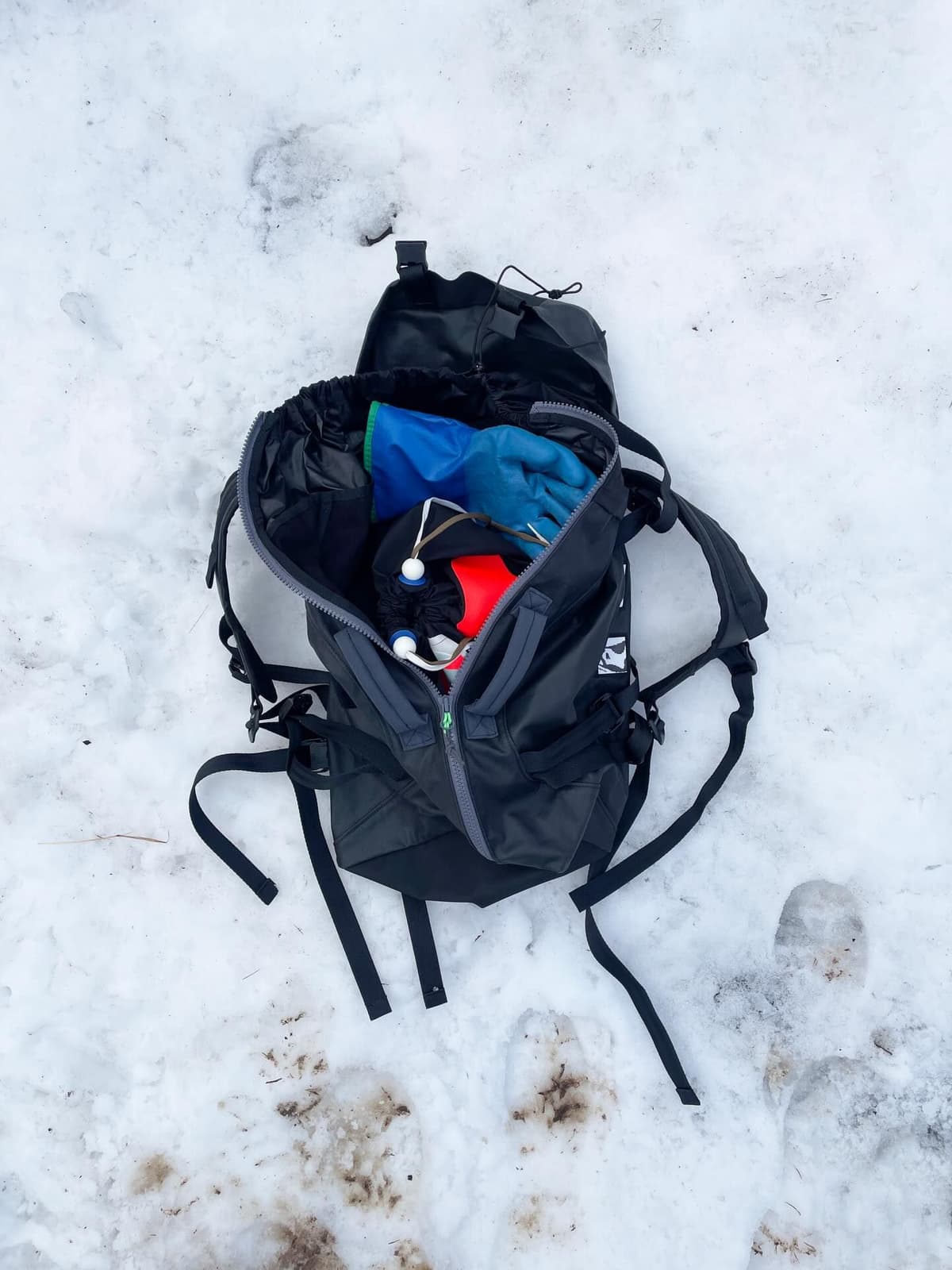
Then there is GR10K, where industrial materials and Italian fashion production push the outdoor-adjacent proposition even further. Its more accessible GR10K Replicated collection currently includes €170 trousers, €180 cargo trousers, €225 blousons, €245 chore jackets and a €280 half-zip fleece.
The main collection goes considerably higher. SS26 included €490 wool field pants, €340 three-layer shorts and a €640 three-layer poncho at original retail prices.
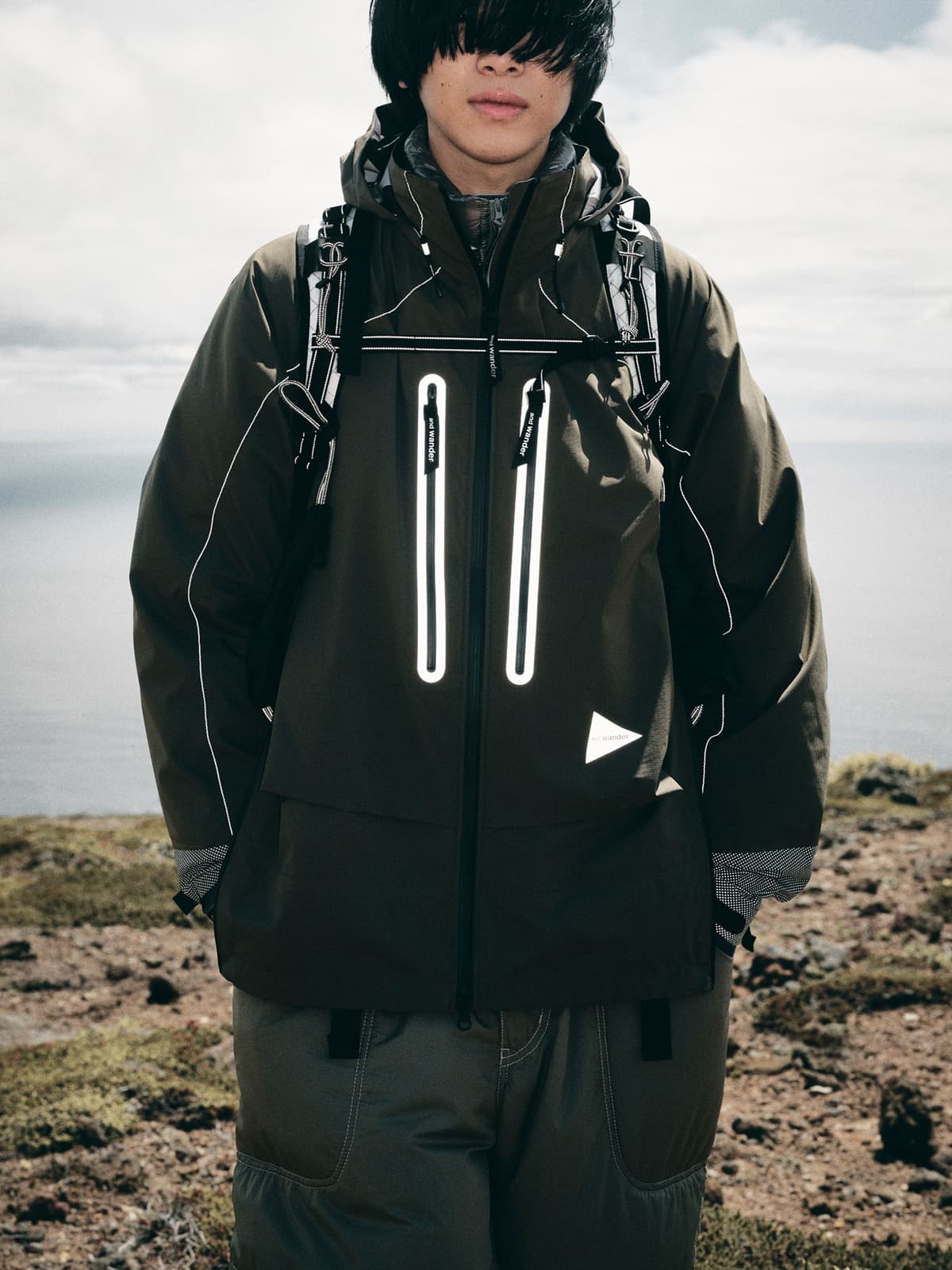
and wander offers another useful benchmark because it helped establish much of the visual language today's independent outdoor market operates within. Current U.S. retail listings put technical cargo shorts around $350, hiking pants around $404 and a technical shell around $558 at original retail.
Put these brands together and a clearer picture emerges.

The Accessories Problem
Then there are the little things.
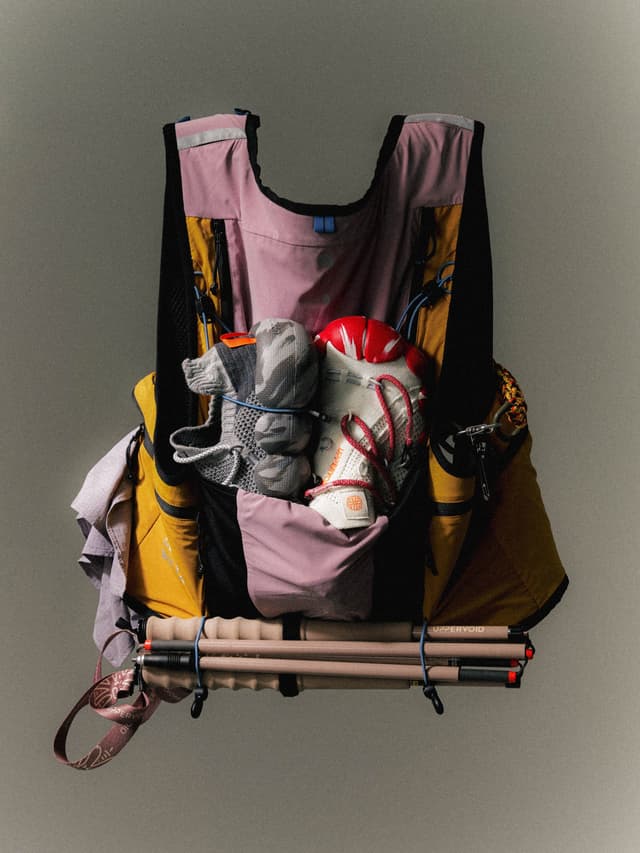
A technical cap can now cost $50–$80. Performance socks routinely approach $25–$35. A water bottle can be $50. A pair of hiking shorts can cross $150.
Individually, none of these numbers feels particularly shocking anymore.
Collectively, they reveal something important: outdoor has developed its own version of the luxury accessory economy.
For someone unwilling or unable to spend $600 on a jacket, a cap, bottle, carabiner or pair of socks offers a lower-cost way into a brand's world. These products function as equipment, but they also function as badges of participation.
The $65 cap is outdoor's version of the designer wallet.

Performance Is No Longer Enough to Explain Price
The old outdoor hierarchy was relatively straightforward: better performance justified higher prices.
That's becoming harder to maintain.
Material technology has diffused throughout the market. Excellent waterproofing, lightweight fabrics and advanced foams are available to more companies. The functional difference between a good $250 product and a good $500 product can sometimes be surprisingly narrow.
What fills the gap is everything surrounding the object.
Design. Scarcity. Manufacturing location. Collaboration. Community. Storytelling. Taste.
In other words, brand.
That isn't necessarily a sign that outdoor has lost its way. It's evidence that the category has matured into a cultural market rather than simply an equipment market.

The Price of Entry Is Rising. And Falling.
There is a contradiction at the center of the current outdoor economy.
New gear is getting more expensive, while getting outdoors has arguably never required less new gear.
The resale market is enormous. Previous-season technical clothing is widely available. Gear rental has expanded. Twenty-year-old fleece has become desirable rather than obsolete. Repair has moved from a niche environmental practice toward an aesthetic and cultural position of its own.
A consumer can spend $1,500 assembling this season's kit.
Another can spend $200 on used gear and accomplish exactly the same hike.
Both can participate in contemporary outdoor culture.
That distinction may become increasingly important.

The WeekEnds Price Index
These aren't judgments about what any product should cost. They're a way of establishing where the market currently sits—and giving us something to measure against as it moves.
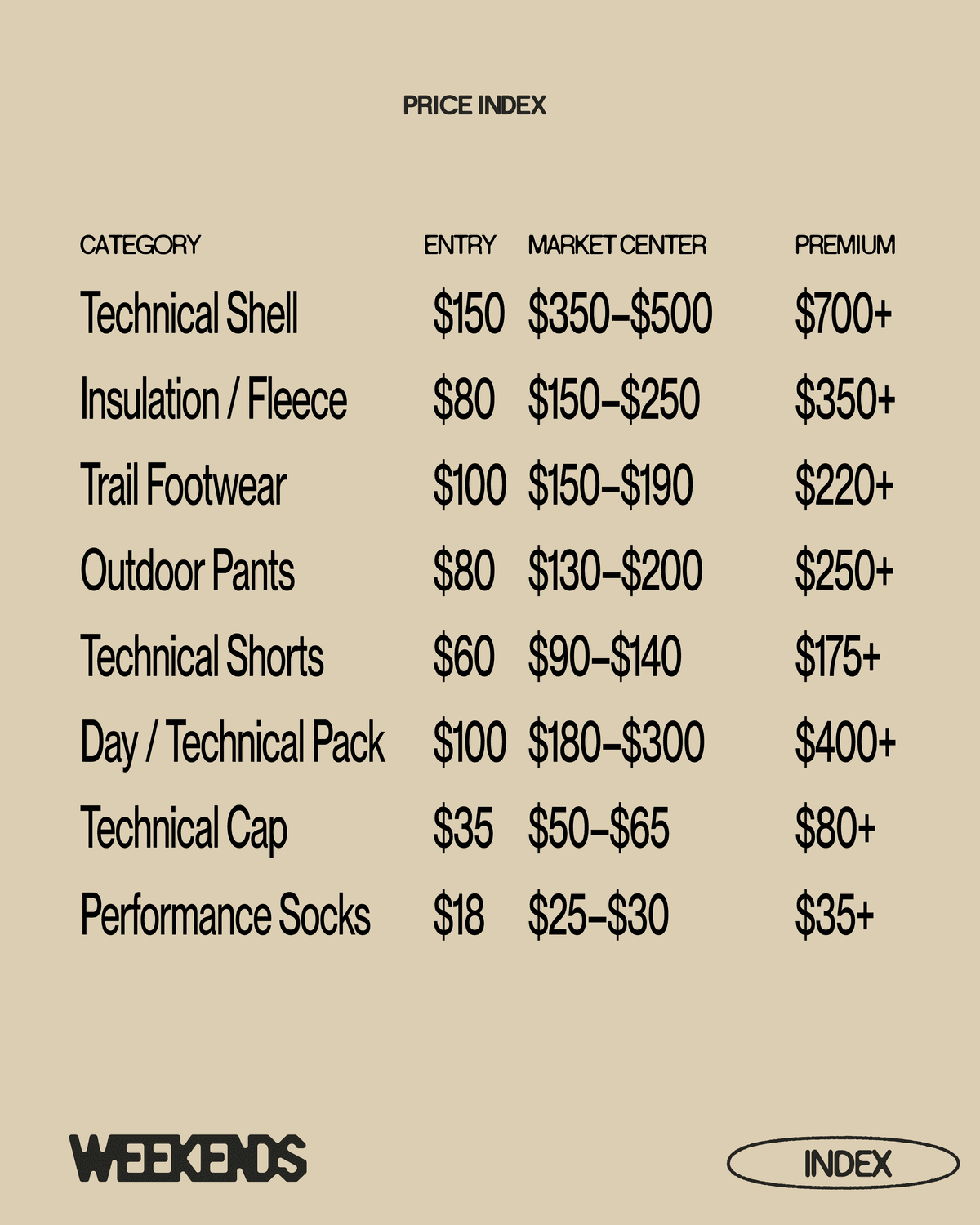
Because the most useful question isn't whether a $600 shell is expensive.
Of course it is.
The more interesting question is where that $600 actually goes.
Some goes into materials and construction. Some goes into research and development. Some goes into marketing and retail margins. Increasingly, some goes toward absorbing the friction of moving an extremely complicated object through an increasingly complicated global economy.
And then there is the premium consumers are willing to pay for design, scarcity and belonging.
Understanding the difference between those costs may become one of the most important ways of understanding the outdoor market.

What We're Watching
The next phase of outdoor pricing may not simply be continued inflation at the top.
The bigger question is whether today's higher costs become structural.
Tariffs can change. Freight rates can fall. Currencies move. Material costs fluctuate. But brands making sourcing decisions today are increasingly building their businesses around the assumption that global trade will remain less predictable than it once was.
That favors scale in some ways. Large companies have purchasing power, logistics infrastructure and the ability to move production between countries.

But uncertainty can also create openings for smaller businesses willing to operate differently: shorter supply chains, fewer SKUs, local manufacturing, preorders, direct-to-consumer distribution, repair programs and products designed to remain relevant for years instead of seasons.
For decades, outdoor brands competed primarily over who made the best gear.
The next decade may be defined by a more complicated question:
Who can make the economics of making good gear still work?
The Price Index is part of the WeekEnds Market Report, our ongoing look at the products, brands, economics and cultural shifts reshaping the outdoor market.
Related Articles

August 19, 2026
Why Repairability Is Becoming a Design Feature
Explore why repairability is becoming a core outdoor design feature, as brands rethink durability, longevity, modularity, and product lifecycles.
Read →
August 16, 2026
Outdoor Jackson and the New Outdoor Consumer-Creator
Outdoor Jackson on the new outdoor consumer, the rise of digitally native brands, fashion vs. function, social media, and the future of outdoor culture.
Read →
August 13, 2026